Posts

Ed Thorp: Interview in 2018

There is a short beautiful interview of Ed in Barron's in early 2018. Some of the key points from that are below. Why are some tables hot and cold? If the game is honest, most of the time it’s just random fluctuations. Those random fluctuations are what I think of as luck. That stock market drift you're talking about—are those the real numbers? It is five basis points a day. Multiply that by 250 days, and it’s about 12.5%. The historical geometric growth is about 10.5%, because of the fluctuations. Given that drift, is stock-picking even worth it? There are three types of investors. One wants to do well and not spend a lot of time. Those should be passive investors, and they will beat most of the others who will be dragged down by fees and costs and punished by what I call “the scared-rabbit syndrome,” which is that they run out at the bottom and get back in at the top. The index investors who just buy and sit avoid all these issues. Then there is the small group ...

Ed Thorp's Views on Markets Today

Image
I kind of admire Ed Thorp so I am biased with whatever is even related to him. On Twitter he shared a few sets of Q&A. I want to mark it for future reference for myself.

Buffett Letter: 1963 semi-annual 2

1963 Semi-annual 2 This semi-annual letter again is very short outlining operational tasks for partners. Therefor not of much use in terms of learning. Buffett says that a 'moderate' annual edge over the Dow should be satisfactory. He says this because his fund is 13% odd above Dow's return in 1963.

Buffett Letter: 1963 semi-annual 1

1963 Semi-annual 1 This letter in my opinion does not have many new points. Buffett repeats his views on how his fund would do better in a declining market vs a rising market where it would lag the index. He talks about how index is a strong competitor. And so on. One thing I realized in this letter was that he is also shorting stocks when he talks about his net investment positions in Generals. Buffett makes a very important statement -  Investment decisions should be made on the basis of the most probable compounding of after-tax net worth with minimum risk.

Buffett Letter: 1962 semi-annual 2

1962 Semi-annual 2 Buffett likes clarity. Supreme clarity. He even proposes axioms for his investors in this letter. He says his performance needs to be bench marked against the index Dow in this case. If he does better than the Dow they will be pleased if not he 'deserves tomatoes'. 5 year test for performance is what is preferable to him. 3 years is minimum. Reiterates he is not in the business of predicting stock market. He makes 3 promises to his investors Investments will be based on value and not popularity Risk of  permanent  capital loss will be minimized though there will be quotational losses. This he will achieve by having a margin of safety in his investments. He has skin in the game because his family's networth is invested in this fund. He makes an 'unscientific' opinion by saying that 10% alpha over Dow over a 10 year period is the maximum one can achieve.  One of the greatest point he makes again:  Dow is no pushover as an index of ...

Beating the street....in vain

Image
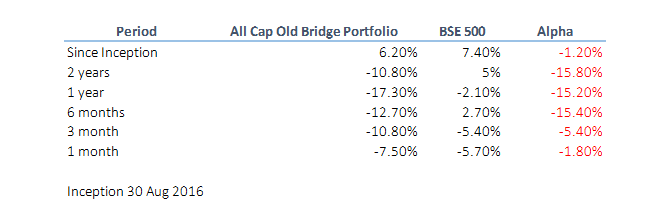
The failure to beat the index is one of the core messages I have seen in the first few letters of Warren Buffett. This is a very difficult thing to do on a consistent basis. Kenneth Andrade is one of the popular fund managers in India. I believe he did a spectacular job managing a mutual fund. I have only heard and not seen the numbers. But I go by what others tell me. Today in multiple groups I received his August 2019 update. And it reaffirms how difficult it is to beat the index.  His Old Bridge All Cap fund has as good as a fixed deposit unfortunately. I hope his picks give his investors the alpha they have been looking for. Few years ago I had reached out to the company inquiring whether they could manage my money. Luckily they were not taking more money. Kenneth has a nice point in his letter which goes as A thought does cross the mind – was I really lucky in my journey as a portfolio manager between 2003 - 15. In the last 20 years, I had never to explain and the...

Lynch Learnings: Part 1

It's worth reminding ourselves that bull markets don't last forever and that patience is required on both sides. The typical winner in the Lynch portfolio takes 3 to 10 years to play out. Stock price is the least useful information but it is the most widely tracked. On the internet companies Lynch says that few companies will dominate the area. Shareholders in these triumphant companies will prosper, while shareholders in the laggards, the has-beens, and the should-have-beens will lose money. Whenever you invest in a company you are looking for its market capitalization to rise. When looking at a company who has say a 100 or a 200 PE look at what it revenues need to be at say a 40 PE. Then see whether that revenue exists today for a company or not. It will be rare that such an enormous amount of revenue will be generated by some company. On internet businesses he says there are 3 ways to invest in this theme - First is the 'pick and shovels' method. In the gol...